
Title

Santa Barbara's Changing Climate: Flooding & Erosion

Body

Santa Barbara is experiencing more frequent flooding, changing coastlines, and hotter days. These shifts are driven by a combination of global climate change and local environmental factors. From rising sea levels to more intense storms and heatwaves, the science helps us understand what’s happening—and how we can respond. Scroll down to learn more.

Sections
2025_11_06 King Tide E Beach Mission Creek 02.png
Loss of Sandy Beach
Thousand Steps Wave January 2025
Cabrillo Castillo Flooded December 2023

Flood Risks are Changing

Santa Barbara’s mountains, creeks, and beaches are all connected. Climate change is causing bigger storms, hotter days, and rising sea levels. These changes affect how water moves through our city and shape our coastline.

Historically there were more frequent smaller storms. Today, there are bigger storms less often with drought in between.

Heavy rainfall overwhelm the Creek channels and stormwater pipes, which causes flooding in urban areas and at the beach.

Photo: Mission Laguna Estuary during a King Tide, November 2025.

Today's Impacts and Tomorrow's Challenges

In Santa Barbara, this change is already visible along our coastline, and it’s expected to accelerate in the coming decades. High tides and storms are flooding low-lying areas, eroding beaches, and damaging parks, roads, and buildings near the waterfront.

As sea levels rise, these impacts will become more frequent. Current infrastructure is not sized to manage the larger volumes of water from the combination of sea level rise, inland storms, and big wave events.

The Adaptation & Resilience Program is developing Adaptation Plans to upgrade infrastructure to handle more water and make Santa Barbara more resilient to these changes. 

Photo: East Beach during a King Tide, November 2025

Beaches are Narrowing

Santa Barbara’s beaches are getting narrower due to erosion and rising sea levels. For example, East Beach is eroding approximately 5 feet per year.

As the waterline moves inland and beaches shrink, there is less space for beach recreation and beach habitats, and less protection for Waterfront infrastructure, like the bike path and Cabrillo Blvd.

Low-lying beaches (e.g., Leadbetter and East Beach) could maintain their width if some Waterfront infrastructure was moved inland, giving the beaches more room to persist into the future.

But beaches that have a bluff behind them (e.g., Mesa Lane and Thousand Steps Beaches) will not have enough room to shift inland. Half of those beaches will consistently underwater with as little as 1 foot of sea level rise – similar to how they are today during high tides. 

Photo: Thousand Steps during a High Tide, January 2025

Flooding in Low-lying Areas

Parts of our city were built on low-lying areas that were previously tidal wetlands. These areas are particularly prone to flooding, and will flood more frequently due to climate change. 

Climate change is impacting local rainfall patterns, leading to storms that produce heavier rainfall over shorter periods of time. This occurs because warmer air in the atmosphere holds more moisture, which leads to more powerful downpours.

Storms that were considered 100-year storms (1% chance of happening each year) will become 10 to 20 year storms (5 to 10% chance of happening each year).

Scenario24-hr Rainfall Event Return Interval 
(% Annual Chance of Occurrence)
Past Precipitation5-year 
storm 
(20%)
10-year 
storm 
(10%)
50-year 
storm 
(2%)
100-year storm 
(1%)
500-year storm 
(0.2%)
Future Precipitation with Climate Change (2030 to 2100)2- to 3-year storm 
(33%-50%)
5-year 
storm 
(20%)
10-year 
storm 
(10%)
10- to 20-year storm 
(5%-10%)
30- to 50-year storm
(2%-3%)

Scroll down to use the interactive FEMA flood map to explore which parts of our city are most at risk today, based on historical trends. You can zoom in to see your neighborhood and learn more about flood zones. 

Photo: Flooded Cabrillo Castillo intersection, December 2023

Damages & expensive maintenance
Disruption of operatations & loss of revenue
Leadbetter King Tide November 2025

Defending the Harbor & Other Critical Infrastructure

The Waterfront is already experiencing flooding, storm surge, and erosion during big wave events and king tides. 

In January 2023, a large coastal storm brought big waves that eroded the beach in front of the Harbor – causing a partial collapse of the Harbor West parking lot and boat yard, damage to Yacht Club’s pilings, and flooding throughout the greater Harbor Commercial area. That storm caused nearly $3 million in damage in the Harbor alone, with more impacts throughout the City.

When these events happen, operations must stop at the Harbor businesses and facilities that support restaurants, shopping, recreation, commercial fishing, and boating. These closures are costly for local businesses and they negatively impact tourism and the local economy.

As sea levels rise and storms intensify, these impacts will occur more frequently and be more severe. However, adaptation strategies can avoid such damages by protecting and transforming the waterfront – defending critical infrastructure, while also providing opportunities to enhance recreation, beach access, cultural resources, and more.

Photo: Harbor West Parking Lot after a big wave event, January 2023.

Safeguarding Access, Recreation, & the Economy

The Santa Barbara Waterfront is a beloved resource that's central to our community's identity and economy, and safeguarding it is essential for both residents and visitors.

Eroding beaches, flooded roads and parking lots, and damaged infrastructure prevent safe access and use of the Waterfront – affecting recreation and the local economy. These disruptions will happen more frequently as sea levels continue to rise without proactive adaptation measures.

The City is developing a Waterfront Adaptation Plan to protect the Waterfront, while also enhancing beach access, recreation, the economy, and other resources. By taking proactive steps now, we can preserve Santa Barbara's iconic beaches, parks, and harbor that support local businesses and make Santa Barbara special.

Photo: Harbor Commercial Area, December 2023.

Sea Level Rise

Sea level rise refers to the gradual increase in the height of the ocean’s surface, driven primarily by climate change through melting ice and the warming of the ocean which causes it to expand. Scientists use different scenarios to plan for the future. For Santa Barbara, the Intermediate-High scenario, from the Ocean Protection Council’s 2024 Sea Level Rise Guidance, is the most likely range we plan for.

Scientists use different scenarios to plan for the future. For Santa Barbara, the Intermediate-High Scenario is the most likely range we plan for.
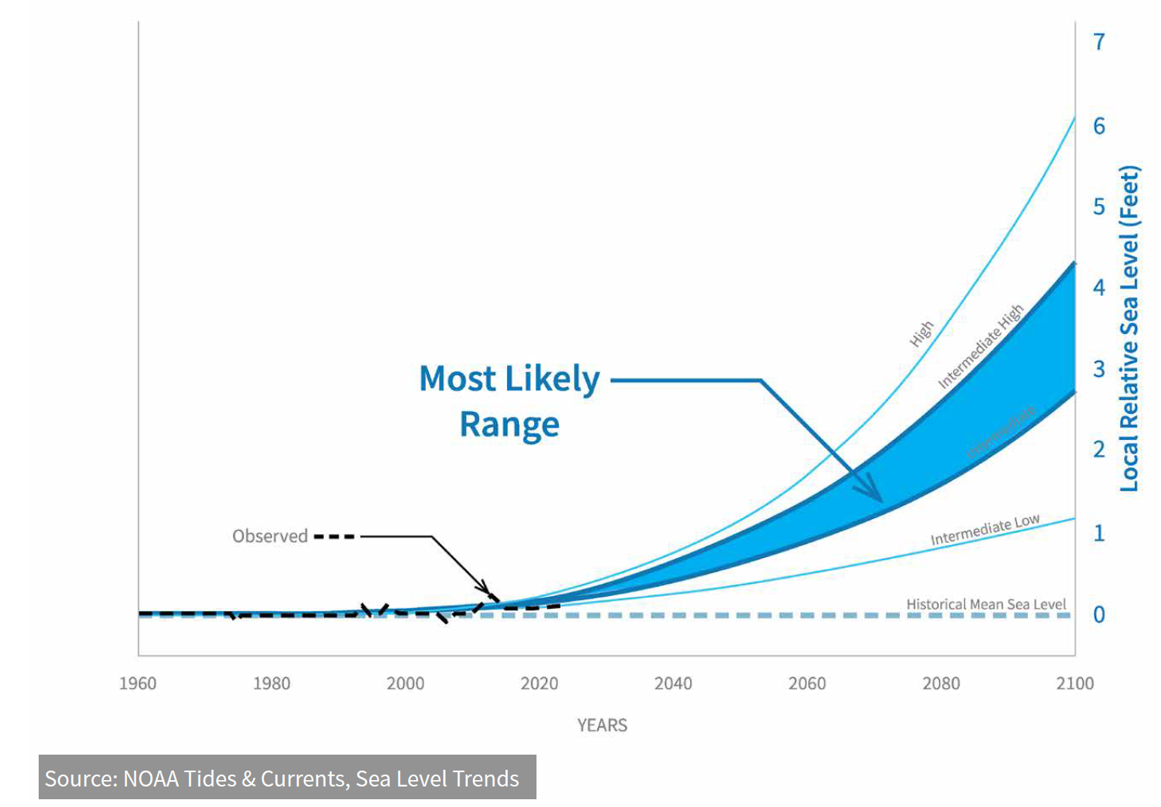
Sea Level Rise Chart

In Santa Barbara, this change is already visible along our coastline, and it’s expected to accelerate in the coming decades. High tides and storms are flooding low-lying areas, eroding beaches, and damaging parks, roads, and buildings near the waterfront.

Use the interactive inundation map below to see how different sea level rise scenarios and big wave events could affect our coastline. Zoom in to explore specific locations and understand what future conditions might look like.  

Photo: Leadbetter Beach during a King Tide, November 2025.

Cabrillo Blvd at Sunrise

A Coordinated City Response

The changes to Santa Barbara’s climate are gradual, but the pace can change. Scientists update their predictions as new data becomes available, helping us understand better what’s coming. The City will also be regularly monitoring sea levels, erosion, flooding, and other environmental conditions to help us know when it’s time to act. That’s why Santa Barbara’s plans need to stay flexible—so we can adjust as conditions change and keep our waterfront safe and accessible.

The Adaptation & Resilience Program’s approach is to phase adaptation in response to the changing environmental conditions, allowing us to prioritize current and emerging hazards while also preparing for the future.

Learn more about the City’s Sea Level Rise Adaptation Plan, Waterfront Adaptation Plan, and other key initiatives.

Photo: Cabrillo Blvd, December 2023.